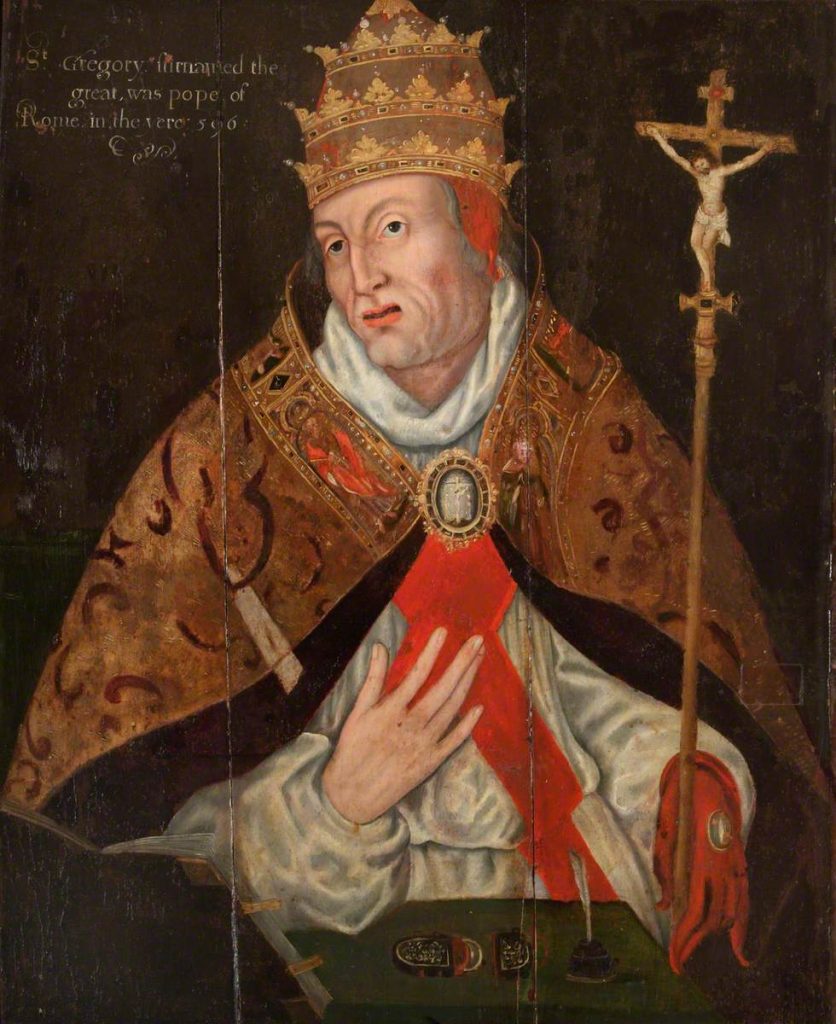
The conversion of Pagans in Early Middle Age England began by Pope Gregory sending a letter to the Abbot Mellitus, which Bede details in his Ecclesiastical History. Bede writes, “Howbeit, when Almighty God has led you to the most reverend Bishop Augustine, our brother, tell him what I have long been considering in my own mind concerning the matter of the English people; to wit, that the temples of the idols in that nation ought not to be destroyed; but let the idols that are in them be destroyed; let water be consecrated and sprinkled in the said temples, let altars be erected, and relics placed there.” The process of conversion from Paganism to Christianity in England was generally acknowledged by historians to be peaceful and organized opposition against the conversion to Christianity was limited. King Alfred of Wessex’s brother, Ethelwerd, wrote in his Chronicle of the conversion of the English. He detailed the arrival of Augustine and his fellow holy men in England, “When these men arrived, the English received the faith and erected temples, and our Saviour Jesus Christ exhibited innumerable miracles to his faithful followers through the prayers of the bishop, St. Augustine.” The first conversion and baptism of an English king was King Ethelbert of Kent around 597. Bede details in Ecclesiastical History that many kings and their subjects converted to Christianity, but did not stop worshipping their own gods and goddesses and practicing their so-called “heathen” ways.
The first of the English kings to ban idol worship and Pagan practices was King Earconbert of Kent in 640. As Pagans did not widely use written documentation to detail their practices, much that is known about Pagans and the process of conversion is from Christian sources such as Bede and the letters from Pope Gregory dispatched to his Abbots and monks. Historian S.D. Church argues that, “Gregory the Great and Bede both derived their understanding of paganism from the Bible and the ancient world in which there were temples and there were idols.” The process of conversion has been written and understood only from a Christian perspective so it is problematic to interpret the process from a Pagan perspective unless viewed from the point of view that Paganism did not just disappear once Christianity became more commonly practiced in Early Middle Age England. Some of the gods and beliefs from Paganism were simply incorporated into the newly emerging Christian religion within England. Historian William Chaney states, “It did not mean that people were not Christian; but that they could see a lot of sense in the old beliefs also.” The people of England embraced Christianity but the Christian religion itself did not exist in a vacuum; certain gods were transmuted into a more Christian-like iteration, such as Woden being interpreted into the Christian Jesus Christ. Chaney states, “The sacrifice of Woden to himself, as the priest that offers and the victim that is offered, with the Sacrifice of Christ, the victim and the priest.” Essentially, Pagans were open and willing to accept Christianity but also maintained portions of their pre-Christian religion that were incorporated into their new beliefs. Pope Gregory simply transformed the Pagan temples into Christian churches and Pagans transformed Pagan beliefs into Christian beliefs.
Parallels existed between Pagan beliefs and the newly accepted Christian religion. Although Christianity may have been monotheistic and Paganism polytheistic, some overlap existed between belief systems. Could Loki, the Pagan trickster and general harbinger of havoc have been represented in some Christian iterations of the Devil? The correlation between Woden and Christ were made apparent in the Christian converts who were wanting to maintain some of their pre-conversion beliefs. And the common image of the serpent, often used in both Paganism and Christianity symbolically overlapped. Historians have asserted that these similarities allowed for a duality between the two religions. Historian William Chaney wrote, “To become an Anglo-Saxon, pagan or Christian, is impossible, but we divorce too much, I think, Anglo-Saxon Christianity from the culture, shaped by paganism, which formed and even warped it.”
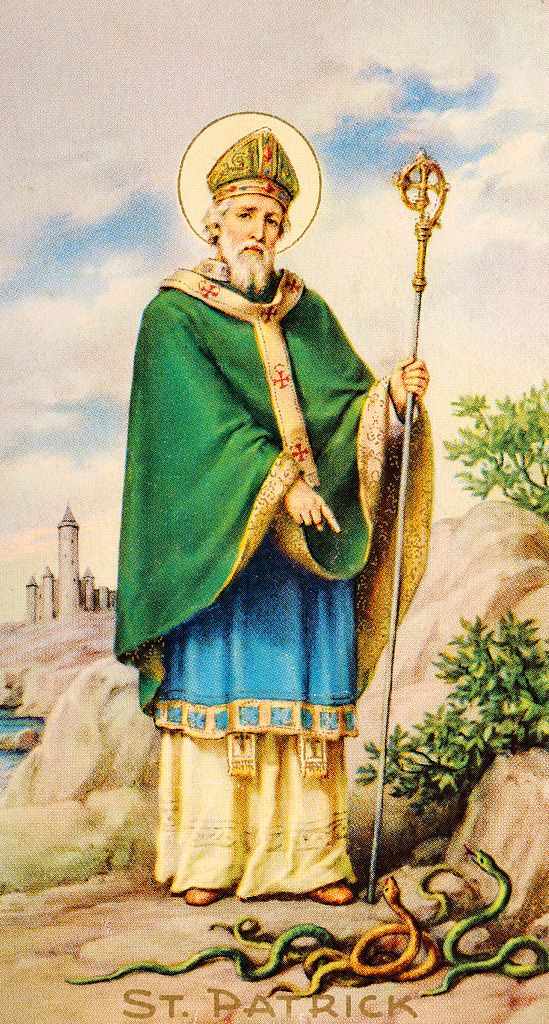
In other parts of Britain, such as Ireland, religious inception was murkier regarding the process of conversion to Christianity. Supposedly, Pope Celestine I dispatched Palladius to become the first Bishop of Ireland, historians have generally surmised in the 5th century. But, St. Patrick is widely credited as spreading Christianity throughout Ireland. There is much debate as to the historical accuracy of St. Patrick and the dates in which Christianity took root in Ireland. As stated by historian Thomas O’Loughlin, “By the early fifth century there were enough Christians in Ireland-certainly Romano-British slaves but probably also native converts-that a bishop was deemed to be necessary, and hence the mission of Palladius.” Whether St. Patrick successfully converted all of Pagan Ireland to Christianity remains a heavily contested question. Much like Bede, who wrote England’s history of conversion, Muirchu of Ireland wrote of St. Patrick’s life and supposed conversion of Ireland. Historians and scholars continue to debate as to whether or not Muirchu’s account of St. Patrick was that of fiction. Muirchu wrote of St. Patrick, “He set out to visit and honour the apostolic see, the head, that is, of all the churches in the whole world, in order to learn and understand and practise divine wisdom and the holy mysteries to which God had called him, and in order to preach and bring divine grace to the peoples beyond the Empire, converting them to belief in Christ.” Whether or not St. Patrick actually converted Ireland to Christianity, Muirchu’s account stands as one of the primary sources of the time of Ireland’s own “ecclesiastical history.”
It can be interpreted from historical analysis of primary sources such as Bede’s Ecclesiastical History that the conversion of Paganism to Christianity in the British isles was a process that took a century of acceptance. Despite the ease in which Christian writers of the time such as Bede and Ethelwerd chronicled the conversion process, there are no Pagan sources to either corroborate or deny the details of what actually happened. From the available sources of the time, historians deduce that the process was relatively straightforward but this could be because Pagan practices did not completely disappear with the entrance of Christianity. Pagans were able to reinterpret some of their previous beliefs to incorporate into Christianity and until some kings outlawed Pagan practices, they were able to have both religion in existence. When reviewing sources from the time, it is important to examine them from the perspective of biased accounts that could contain both fact and fiction.