The term “Anglo-Saxon” is widely referenced to when used in the era of Early Middle Age Britain. In conjunction with Paganism, “Anglo-Saxons” were actually various Germanic tribes that migrated to the British isles who supposedly brought Pagan religions with them. Historian Mary Rambaran-Olm analyzes the use of this term in medieval England. She concludes that it is inaccurate in its representation of encompassing an entire group of people into one “race” as well as term that has been used in a connotation that has established racial superiority and promoted a narrative of nationalism and white supremacy. Rambaran-Olm writes, “Today, far-right identitarian groups seeking to prove their superior ancestry by portraying the ‘Anglo-Saxons’ in ways that both promote English identity and national sociopolitical progress.” While it is convenient to utilize a term that encompasses a large swath of people when contextualizing the past, like Anglo-Saxon does, it is more important to understand how this term has become problematic from a modern perspective and has transformed into a term that is essentially historically inaccurate. Some scholars have attempted to assert that Anglo-Saxon also encompasses the Norsemen who invaded medieval England, which would also prove its historical inaccuracy. How can Anglo-Saxon refer to both Germanic tribes such as the Saxons and the Jutes as well as those who came from Denmark?
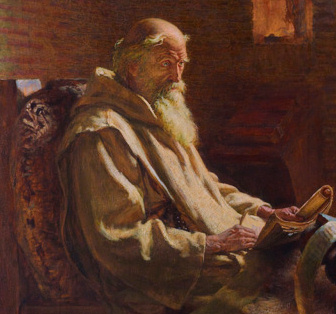
When reading texts of the time, such as Bede’s Ecclesiastical History of England, Christian monk and historian Bede refers to “the nation of the Angles, or Saxons.” He describes the most powerful tribes of Germany as three separate entities, “Saxons, Angles, and Jutes.” When referencing their entrance to the British isles, Bede does not directly refer to them as “Anglo-Saxons” and details their origins as differentiated tribes in their own right. Nennius, a Welsh monk who lived in the 9th century, writes in his History of the Britons about the arrival of Saxons as, “three vessels exiled from Germany” and later refers to them directly as “The Saxons.” Nennius writes, “These are the names of the ancient cities of the island of Britain. It has also a vast many promontories, and castles innumerable, built of brick and stone. Its inhabitants consist of four different people; the Scots, the Picts, the Saxons and the ancient Britons.” The Saxons are their own distinguished people without mention of the term “anglo.”
In The Chronicle of Fabius Ethelwerd, written in 975, Ethelwerd, older brother of King Alfred and historian, recounts the arrival of the Germanic tribes he refers to as various, differentiated groups. He states, “This migration is said to have been made from the three provinces of Germany, which are said to have been the most distinguished, namely, from Saxony, Anglia, and Giota.” He later states, “For out of Saxony, which is now called Alde-Sexe, or Old Saxony, came the tribes which are still called so amount the English, the East Saxons, South Saxons, and West Saxons.” It was only in modern times that the term “Anglo-Saxon” was utilized by historians and scholars who used it to refer to the Pagan immigrants who arrived in England from Germany. As Rambaran-Olm writes, “It was not until the sixteenth century that English antiquarians and scholars began to collect early English manuscripts and compile dictionaries of Old English.” By then, the term “Anglo-Saxon” was being widely used to create a pure English “race” that would allow for a history that encompassed both “heathen” Pagan beginnings that later converted into Christianity, Rambaran-Olm refers to this as a “primitive English church.” By creating this imagined beginning, the term “Anglo-Saxon” was able to be warped into whatever definition suited who was using it, and many times, for justification of racial prejudice and white supremacy.
As stated by Mary Rambaran-Olm, “This white supremacist movement in Euro-America has used the term ‘Anglo-Saxon’ to justify racial violence and colonial genocide for at least 200 years. The racial meaning throughout the English-speaking world deepened and came to be associated crudely with whiteness.” When analyzing Paganism from a modern lens, it is important to remember the connotations of specific terminology and how that terminology can have negative effects on accurately interpreting specific historical events, religions, and people. Through various primary source analysis, it is apparent that the term “Anglo-Saxon” was not used to describe the arrival of Pagan, Germanic tribes who looked to settle in England during the 7th century. This term has been grossly misused in modern iterations and explanations of the English beginnings historical narrative that allow for argument, proof, and rationale for a white supremacist story. This term purports a false account of a people that never existed and were actually a variety of different groups that emigrated to England and brought with them their religious beliefs and practices.