According to Merriam-Webster, the definition of a Pagan is, “a follower of a polytheistic religion (as in ancient Rome)” or alternatively, “one who has little or no religion and who delights in sensual pleasures and material goods : an irreligious or hedonistic person.” It also provides an entry for “Neo-Pagan” which states, “witches, druids, goddess worshippers, and other pagans in America today.” In researching who the Pagans were in Early Middle Age Britain, it is important to note that the term itself is derived from Christian roots. The etymology of the word itself is derived from the Latin word pagus (a country or district) and then paganus (villager), ultimately becoming the Christian Latin version of the word pagan, which translates literally to heathen. This term has been used as a blanket term to refer to a multitude of separate religions originating from various places across the world, including Norse mythology, Ancient Rome, and Celtic Druidism as well as other belief systems that encompassed a polytheistic religion. Ultimately, Pagan is almost a catchall term used by the Christian religion to refer to any belief system that did not directly worship the singular Christian God.
When referring to the term Pagan in a historical context on this website, Pagan will refer to the polytheistic belief system brought to Early Middle Age Britain by various Germanic peoples who emigrated in the 5th century. Many historians tie Pagan beliefs to a few unifying beliefs such as worship of the natural world, worship of gods/goddesses as well as ancestral worship, and ritualist practices such as sacrifices. When reviewing primary sources of the time, the term “Pagan” is not often used to refer to the religious practices of the Germanic tribes that emigrated to England. In Welsh monk Nennius’ History of the Britons, he writes, “not of the omnipotent God and our Lord Jesus Christ (who before the beginning of the world, was with the Father and the Holy Spirit, co-eternal and of the same substance, and who, in compassion to human nature, disdained not to assume the form of a servant), but the offspring of one of their idols, and whom, blinded by some demon, they worshipped according to the custom of the heathen.” The term “heathen” is used frequently throughout his account to refer to those who did not believe in Christianity.
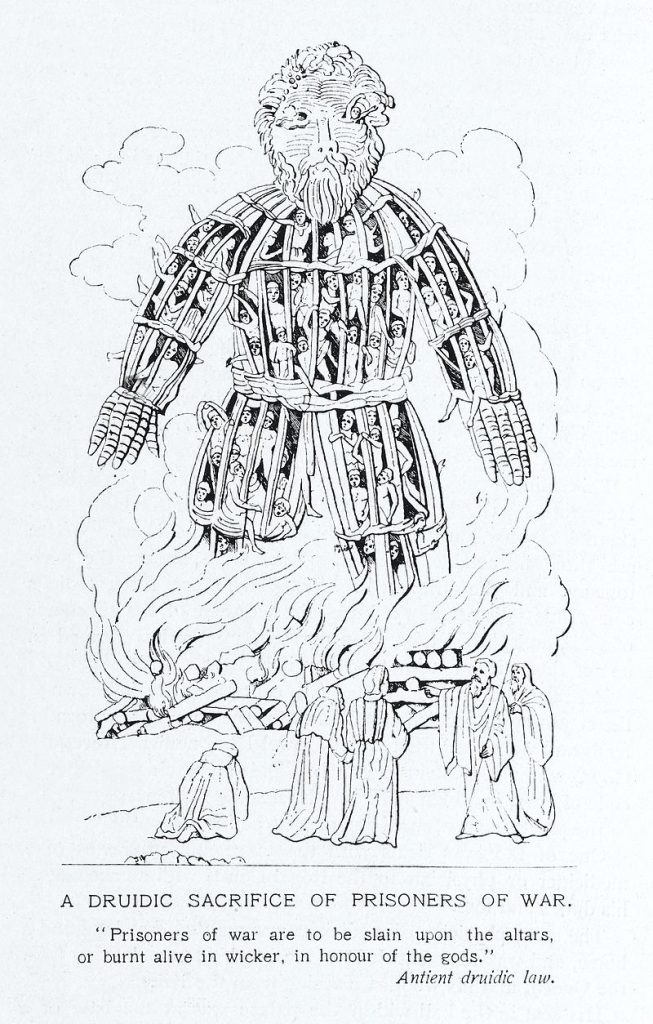
Christian monk Bede, in his Ecclesiastical History, refers directly to the tribes as “pagans.” He writes, “In short, the fire kindled by the hands of the pagans, proved God’s just vengeance for the crimes of the people; not unlike that which, being of old lighted by the Chaldeans, consumed the walls and all the buildings of Jerusalem.” He refers to the pagans directly while also implying that they felt God’s vengeance against the ills they committed as well as generally being non-believers and as Nennius would call them, “heathens.” Historian Marion Gibson in her book, Imagining the Pagan Past: Gods and Goddesses in Literature and History since the Dark Ages states regarding Bede and his accounts of Pagans, “So I would that we can see Bede in the long tradition of writing against the pagans, describing their authentic but despised rites in passing as he tries to give us a Christian history instead.” While Bede refers to Pagans in his writing, his accounts as well as Nennius’ account do not provide an unbiased history of who the Pagans were and what they brought with them to England in terms of religious beliefs when they arrived in England. While Nennius does not directly refer to “Pagans” he implies that they are both heathens and are “blinded by demons.”
Religious beliefs that, according to Bede and Nennius, would be considered “Pagan,” existed in Britain prior to the arrival of Germanic tribes. Celtic Druids inhabited areas of the British isles and were practicing their beliefs before the 3rd century BCE. While Bede and Nennius may have thwarted the existence of “heathens” and “Pagans,” such belief systems were already a part of England. Romans, who came to Britain prior to the arrival of the Germanic tribes, also believed in a pantheon of gods/goddesses that could be considered Pagan as well. In understanding what the term “Pagan” means from a modern perspective, it is important to remember that this term encompassed a wide variety of differentiated religious beliefs that came from multiple different peoples and geographic areas. In some primary source accounts, it seems the word Pagan and heathen are used almost interchangeably, which highlights the unbiased nature of many of these accounts.